 ToddlerBites
Major health bodies converge on around six months for starting solids. That recommendation exists for concrete reasons: by six months a baby's digestive system is more mature, the tongue-thrust reflex that pushes food out has usually faded, head and trunk control is good enough to swallow safely, and the iron stores they were born with are beginning to run low.
But six months is a population average, not a switch. What matters is your specific baby.
When to start baby on solids: which signs matter?
Look for all four together. Any one on its own is not enough — babies chew their fists from about three months, and that is not a readiness signal.
- Sits upright with minimal support. Not wedged into cushions. Stable enough that the airway is properly aligned, because swallowing safely depends on posture.
- Holds their head steady. No wobble when they turn to look at something.
- Brings objects to their mouth accurately. Hand-to-mouth coordination is the mechanical prerequisite for self-feeding.
- Shows genuine interest in food. Tracking your fork, leaning in, reaching for your plate, opening their mouth as food approaches.
✓ The tongue-thrust check
Offer a tiny amount of something soft on a spoon. If the tongue pushes it straight back out every time, the extrusion reflex is still active and it is worth waiting a week or two. This reflex exists to prevent choking, and it fades on its own.
What about starting at four months?
This is one of the most-searched questions on the topic, and it usually comes from one of three places: older family members who were told four months was standard, a baby who seems permanently hungry, or advice about reflux or sleep.
The honest answer: current guidance is to wait until around six months, and not to start before four months under any circumstances. Before four months a baby's swallow coordination and gut are genuinely not ready.
Between four and six months there is more nuance. Some babies do show all the readiness signs early, and some are advised by a doctor to start sooner for specific medical reasons — including, in some allergy-prevention protocols, earlier introduction of particular allergens. That is a decision to make with your pediatrician about your baby, not one to take from a chart.
Two things worth knowing if the pressure you are feeling is about sleep or hunger:
- Solids do not reliably improve sleep. This is one of the most persistent myths in infant feeding, and it does not hold up.
- A hungry-seeming baby usually needs more milk, not food. Early solids displace milk, which is more calorie-dense than most first foods — so starting early can reduce total intake rather than increase it.
⚠️ Talk to your doctor first if
Your baby was born prematurely (readiness is usually assessed from corrected age), has a medical condition affecting feeding or growth, has severe eczema or an existing food allergy, or if you are considering starting before six months for any reason.
What to offer first
There is no required first food and no required order. What matters more:
- Iron from day one. This is the genuine nutritional priority. Well-cooked shredded meat, lentils, beans, egg, tofu, or iron-fortified cereal — something iron-rich every day.
- Single ingredients at first. Not because mixing is risky, but so you can identify the cause if there is a reaction.
- Soft enough to squash between thumb and forefinger.
- Vitamin C alongside plant iron — soft fruit or peppers with lentils meaningfully improves absorption.
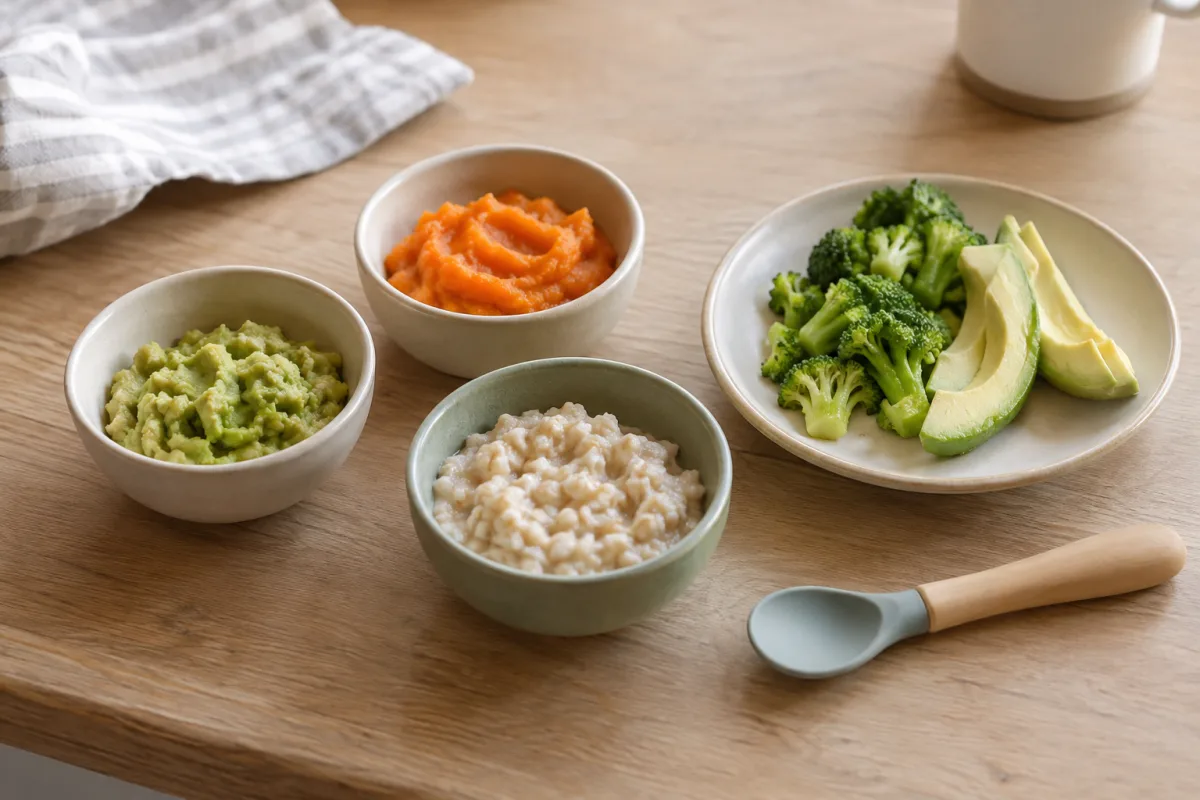
Good starters: avocado, steamed sweet potato, broccoli florets, banana, roasted carrot batons, toast fingers, full-fat plain yoghurt, well-cooked shredded chicken.
Know what's safe at every stage
ToddlerBites screens every recipe against your baby's exact age and listed allergens, and tells you the right texture and cut for the stage they're at now.
Get ToddlerBites freePurees, finger foods, or both?
Both work. Spoon-fed purees make it easier to be confident about how much iron has actually gone in. Baby-led weaning — offering soft finger foods from the start — gives earlier exposure to varied textures and lets the baby regulate their own intake.
Most families do a mix, and there is no evidence that one produces better long-term outcomes. The best method is the one you can do calmly and consistently.
The first few weeks, realistically
- Almost nothing will be swallowed. Early meals are sensory practice, not nutrition.
- Once a day is plenty to begin with, building to two or three meals by around 8–9 months.
- Offer food after a milk feed at first, not instead of one — milk is still doing the nutritional work.
- Gagging is normal. It is loud, protective, and different from choking. The distinction matters and is worth learning before the first meal.
- Expect mess. Playing with food is part of learning to eat it.
⚠️ Never before 12 months
- Honey — infant botulism risk, including baked into food
- Cow's milk as a main drink — fine in cooking
- Added salt — infant kidneys can't process it
- Added sugar
- Unpasteurised dairy, raw or undercooked egg, raw fish
- Rice drinks — not suitable under 5
Next: what to offer month by month from 6 to 12 months, or 35 first foods and how to cut them safely.
Frequently asked questions
When should a baby start solid food?
Most babies start solids at around 6 months, once they can sit upright with minimal support, control their head, bring objects accurately to their mouth, and swallow food rather than automatically pushing it out.
Can a baby start solids at four months?
Solids should not start before four months. Between four and six months, individual readiness and medical circumstances matter, so discuss an earlier start with the baby's clinician rather than relying on age alone.
What are good first foods for a baby?
Soft avocado, steamed vegetables, banana, egg, iron-fortified cereal, lentils, and tender shredded meat can all work. Include an iron-rich food regularly and use textures the baby can manage safely.
Does starting solids replace breast milk or formula?
No. Breast milk or formula remains the main source of nutrition throughout the first year. Early solid meals build feeding skills, introduce textures and allergens, and provide nutrients such as iron.
A note on this guide. This article is general information, not medical advice. Every child is different, and children with medical conditions, developmental differences, or feeding difficulties need an individual plan. Always talk to your pediatrician or health visitor about your own child.