 ToddlerBites
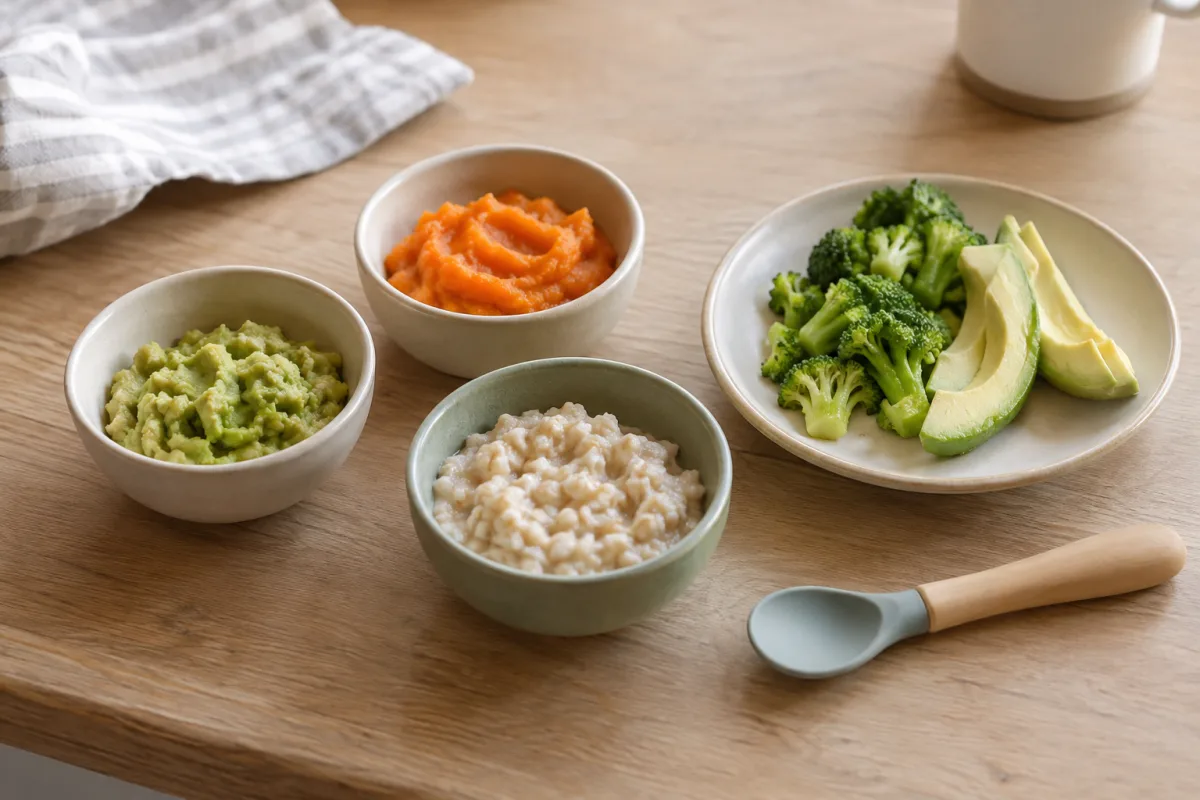
Baby-led weaning (BLW) is an approach to starting solids where you skip purees and spoon-feeding entirely. Instead, from around six months, your baby is offered soft finger foods they pick up and feed themselves. They set the pace, decide how much to eat, and explore food with their hands as much as their mouth.
The term was popularised by UK health visitor Gill Rapley in the mid-2000s, and it has since become one of the two mainstream routes into solids — the other being traditional puree-then-lumps-then-finger-foods.
Plenty of families do a mix of both. That's fine. There is no prize for purity here, and a baby who eats yoghurt off a spoon and broccoli off the tray is doing beautifully.
What is baby led weaning, and when can you start?
Around six months — but age is the weakest of the signals. What matters is whether your baby can physically manage self-feeding. Look for all four of these together:
- Sits upright with minimal support. Not propped in a nest of cushions — genuinely stable, because swallowing safely depends on an upright airway.
- Holds their head steady. No wobbling or lolling when they turn to look at something.
- Brings objects to their mouth deliberately and accurately.
- Shows real interest in food — tracking your fork, reaching for your plate, opening their mouth.
A baby who has just turned six months but can't yet sit steadily is not ready. A baby who ticks every box at 25 weeks is still better served by waiting until 26. The guidance to start at six months exists partly because babies' digestive and immune systems are more mature by then, and partly because that's when the iron they were born with starts to run low.
⚠️ Before the first meal
Take an infant first-aid course, or at minimum watch a current video on infant choking response from a recognised body such as the Red Cross. Every parent starting solids should know what to do — by whichever method. It takes twenty minutes and it is the single highest-value thing on this page.
Gagging is not choking
This is the part worth reading twice, because confusing the two causes a great deal of unnecessary panic — and, occasionally, unnecessary intervention that makes things worse.
Babies have a gag reflex triggered much further forward on the tongue than adults do. It moves back over the first year. That forward reflex is protective: it exists precisely so that a baby learning to eat can push food back out before it becomes a problem. Gagging is the system working.
| Gagging | Choking |
|---|---|
| Loud — coughing, spluttering, retching | Silent |
| Baby is moving air | Cannot cry, cough, or breathe |
| May go red in the face | May turn blue, especially around the lips |
| Eyes may water; tongue thrusts forward | May look panicked, or oddly still |
| Stay calm, stay close, let them resolve it | Act immediately — back blows and chest thrusts |
The instinct to reach into a gagging baby's mouth and sweep the food out is strong, and it is the wrong move — a blind finger sweep can push food further back and turn a gag into an actual obstruction. Let a gagging baby work it out. Stay visibly calm, because they will read your face.
On the underlying question: studies comparing baby-led approaches with traditional spoon-feeding have not found a higher rate of choking in BLW babies, as long as unsafe foods are avoided. The risk lives in the food shapes, not the method.
How to cut food safely
At six months, most babies have a palmar grasp — they rake food into a closed fist and eat what pokes out the top. So the shape you want is a finger-length strip, roughly the size of an adult pinky finger. Long enough to stick out of a fist. Soft enough to squash between your thumb and forefinger.
Around 8–10 months the pincer grasp arrives — thumb and forefinger — and you can move to smaller, pea-sized pieces.
A reliable test: if you can't squash it easily between your thumb and index finger, it's too firm for a six-month-old.
⚠️ Never serve these to babies or toddlers under 4
- Whole grapes, cherry tomatoes, blueberries — quarter them lengthways
- Whole nuts — use smooth nut butter thinly spread instead
- Popcorn
- Raw hard vegetables — raw carrot, raw apple. Cook until soft
- Hot dogs or sausage cut into coins — the exact diameter of a small airway
- Chunks of meat or hard cheese
- Sticky spoonfuls of thick nut butter
What to avoid under 12 months
Separate from choking, a few foods are off the list for other reasons:
- Honey — risk of infant botulism. This includes honey baked into food. Genuinely no honey until after the first birthday.
- Cow's milk as a main drink — fine in cooking or a little on cereal, but breast milk or formula stays the primary drink until 12 months.
- Added salt — infant kidneys can't handle it. Watch stock cubes, bread, cheese, and anything from a packet.
- Added sugar — no nutritional need, and it shapes preferences early.
- Unpasteurised dairy, raw or undercooked eggs, raw fish.
- Rice drinks — arsenic content; not suitable as a milk substitute under 5.
Every recipe, already checked against your baby's age
ToddlerBites screens every recipe for allergens you've listed, age-appropriate textures, and choking hazards — and tells you exactly how to cut each food for the age your child is right now.
Get ToddlerBites freeWhat to serve in the first week
Start simple and single-ingredient — not because mixing is dangerous, but because if a reaction happens you want to know what caused it. Good first foods are soft, graspable, and nutritionally worth the effort:
- Avocado — wedges, skin off. Slippery, so try rolling in a little baby cereal for grip.
- Steamed sweet potato — cut into fat batons, cooked until a fork goes through with no resistance.
- Steamed broccoli florets — the stem is a natural handle.
- Banana — cut in half crossways, then peel down halfway so there's something to hold.
- Roasted carrot batons — soft all the way through, never raw.
- Toast fingers with a thin scrape of unsalted butter or smooth nut butter.
We go through this in far more detail, food by food, in 35 baby-led weaning first foods and how to cut them safely.
Don't forget iron
The iron a baby is born with starts running low around six months, and breast milk is not a rich source. From the start of solids, offer iron-rich foods daily: well-cooked shredded meat, lentils, beans, tofu, egg yolk, or iron-fortified infant cereal. Serving them alongside vitamin C — a few pieces of soft fruit, some pepper strips — helps absorption.
Allergens: introduce early, not late
Guidance reversed direction here, and plenty of well-meaning advice is still a decade out of date. Current recommendations are to introduce common allergens early, from around six months, rather than delaying them.
The practical approach: one new allergen at a time, in a small amount, earlier in the day rather than at bedtime so you have waking hours to watch. If it goes fine, keep it in the rotation — regular ongoing exposure matters, not just a single introduction.
The main allergens to work through are milk, egg, peanut, tree nuts, soy, wheat, fish, shellfish, and sesame.
Talk to your doctor first if
Your baby has severe eczema, an existing food allergy, or there's a strong family history of allergy. In those cases the introduction plan should be made with your pediatrician or an allergist — sometimes with the first exposure supervised.
Setting up the meal
- Always upright, always in a high chair with good foot support. Feet dangling makes stability worse; a footrest genuinely helps.
- Never in a car seat, bouncer, or while lying back.
- Never unattended. Not for the length of one text message.
- Eat together when you can. Babies learn chewing by watching you do it.
- Two or three items, small amounts. A loaded tray is overwhelming.
- Expect very little to be swallowed at first. Early meals are a sensory experiment. That's the point.
What normal actually looks like
Normal is: most of it on the floor. Normal is a food eaten happily for a week and then rejected. Normal is gagging in the first few weeks. Normal is a nappy that tells you sweetcorn passed through unchanged.
Milk is still doing the nutritional heavy lifting until twelve months. You are not trying to hit calorie targets — you're building familiarity, chewing skill, and a relationship with food that isn't adversarial.
If your baby suddenly refuses food they previously liked, that's usually developmental rather than a problem. We cover the common causes in why is my toddler not eating all of a sudden.
Frequently asked questions
Is baby-led weaning better than purees?
Neither has been shown to be clearly superior for long-term outcomes. BLW may help with self-regulation of appetite and earlier exposure to varied textures; puree feeding makes it easier to be certain how much iron a baby has actually taken in. The best method is the one you can do calmly and consistently.
How much should my baby eat?
At six to eight months, possibly almost nothing — and that's fine. Milk feeds shouldn't drop much at first. Solids gradually take over across the second half of the first year.
Can I do both?
Yes, and most families do. Offering finger foods alongside a loaded spoon your baby can grab is a perfectly reasonable middle path.
My baby has no teeth. Can they still do this?
Yes. Babies mash soft food very effectively with their gums, which are harder than they look. If a food is soft enough to squash between your fingers, gums will handle it.
A note on this guide. This article is general information for healthy, full-term babies, not medical advice. Babies born prematurely, or with medical conditions, developmental differences, or feeding difficulties, need an individual plan. Always talk to your pediatrician or health visitor about your own child — and seek immediate medical help if you have any concern about your baby's breathing.