 ToddlerBites
By the end of a busy day, breakfast can feel like last week. Perhaps you remember the rejected peas but not the lunch your partner served. A short meal note can make the next conversation easier without turning every bite into a task.
Start with the question you want the record to answer. Is another caregiver taking over? Are you trying to remember which version of a dish your child tried? Do you want to bring clearer examples to an appointment? That purpose should decide how much you write.
What belongs in a toddler meal log?
Use the same few fields each time so another adult can scan an entry quickly. Separate food offered from what you actually observed being eaten. A photo of a full plate shows what was served; an empty plate alone does not tell you how much landed on the floor.
| Field | What to write |
|---|---|
| Date and time | The meal or snack time, with an approximate time if needed. |
| Food offered | The food and any preparation detail you want to remember. |
| What you noticed | A brief observation, such as “tried the sauce separately.” |
| Context | Who was there and anything relevant to the handoff. |
| Follow-up | A question or practical reminder for the next caregiver. |
Copy this simple meal log template
Keep a blank copy in your notes, then duplicate it when useful. Leave a field empty if it does not matter for that meal.
Date:
Time and meal/snack:
Caregiver:
Food offered:
What I noticed:
Context or practical note:
Question or follow-up:
A worked example without a meal score
Illustrative entry: “Tuesday, around 12:15, lunch with Dad. Pasta, sauce on the side, and soft cooked vegetables offered. Ate some pasta; dipped one piece in sauce. Left the vegetables. Next time: remember the small fork.”
This tells the next adult more than “bad lunch.” It also leaves room for uncertainty. If you did not see the meal, write “Grandma reported…” rather than filling in details from memory. You do not need an exact percentage to preserve a useful observation.
Choose a routine you can actually keep
Try recording the meal that tends to get lost between caregivers first. Save a short note after the meal rather than interrupting your time together to edit it. If an entry is missing, label the gap; there is no need to reconstruct every mouthful.
Once several entries exist, look for a practical next step: a dish to repeat, a container to replace, or a question to ask. Avoid using the record to compare siblings or to award good and bad eating days.
How ToddlerBites can help
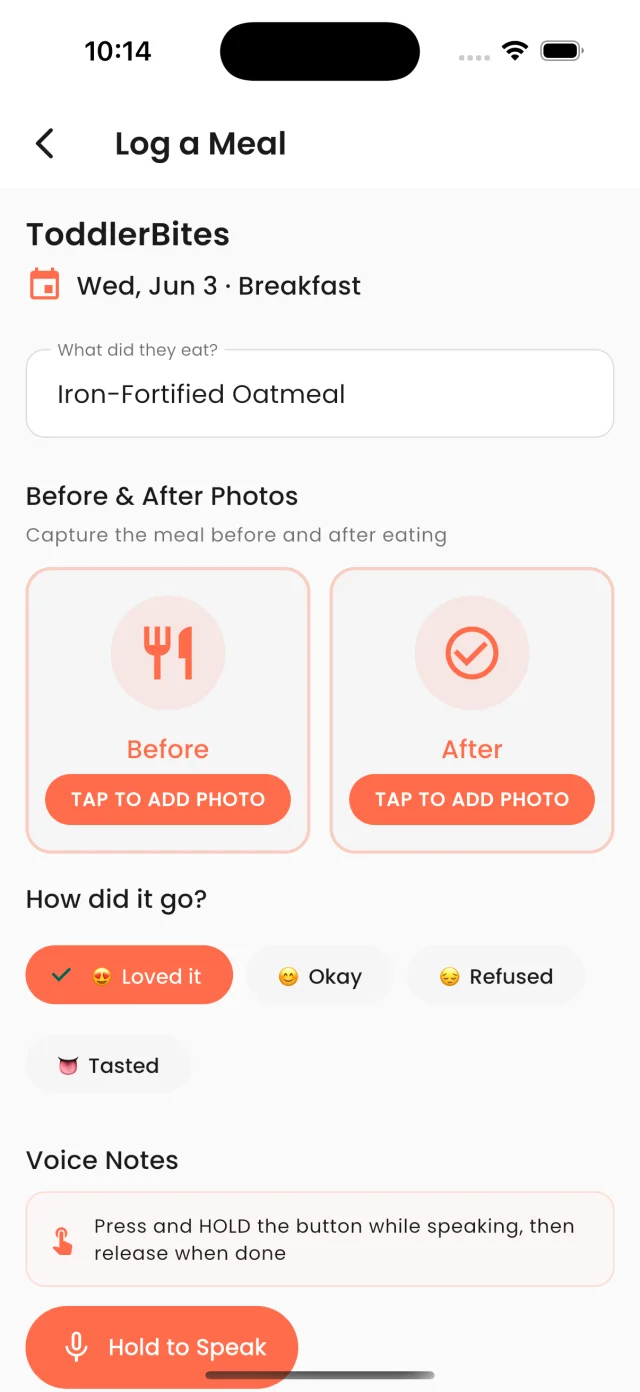
ToddlerBites brings meal history, notes, and photos into the app, with a PDF meal-report export. The same short observations you would put in this template can make an app entry more useful. For coordinating people, see our caregiver feeding-note template.
If your clinician has requested a food record, ask which details and time period they need. Use their instructions rather than assuming a general template captures everything. A log cannot establish that a child is getting enough nutrition.
What if tracking makes me worry more?
Use less detail, focus on a specific handoff, or pause optional tracking. CDC notes that children may eat different amounts on different days and recommends speaking with their doctor or nurse when intake is a concern. Read CDC’s mealtime guidance.
The point is to make a useful detail easier to remember. You can keep a helpful record without keeping a perfect one.
A little help for your next meal.
Explore the app, a free meal plan, and practical guides for your family.
Find your starting pointGeneral information, not individualized medical advice. Follow your child’s care plan and speak with their clinician about feeding or growth concerns. Examples and templates on this page are illustrative.